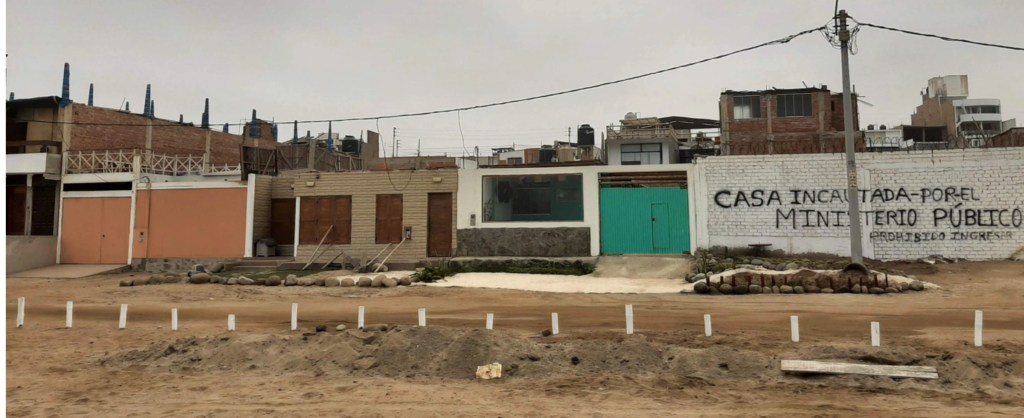
When I got to Punta Negra – a tiny, quiet beach town about 30 miles south of Lima – the first thing I noticed was the slow, bassy build of the waves.
They were the biggest I’d ever seen, the loudest and slowest I’d ever heard. They crashed one by one, a slow motion metronome, fifty meters from my front door. I could hear them even in my bedroom in the back of the casita, even with all doors closed. I could feel them, too, in the bed, in the floor, a low vibration that felt calming and purposeful.
My first night there, I got a text from Cinthia at midnight – Did you feel that?
Me: Feel what?
Her: Tremors. They happen every so often. They’re mini earthquakes but they’re good because they release tension so it means not as severe earthquakes next time. Don’t be scared.
It took me a minute to understand. Oh. Right. There’d been one wave, or so I thought, that was bassier and shakier than the others. Just barely. I’d thought it was just a slightly bigger wave. That’s how physical the waves were – like mini earthquakes.
*
The next night, I sat on my patio, lit a candle and opened up my notebook to write.
I’d come to Peru to find peace. My life had changed drastically in the last months – an almost-6-year relationship ended; the house I had been trying to buy all year had fallen through. The future I’d imagined had dissolved, and nothing had yet shown itself as a new path. I felt lost and uncertain, and in my worse moments, like every choice I’d made had been wrong.
Here, though, in my beach casita with nobody around, listening to the waves, I could breathe in deeply.
I felt the urge to put music on, but I also wanted to listen to the waves, their slow rolling bass. I wanted something to interweave with them, not cover them up. A duet, not a solo. So I put on some Satie, Gymnopedie #1.
I remembered my old disdain for him, my youthful dismissal of anything that spacious and simple. In college, it felt empty, boring, lifeless. I thought anyone could write music like that. I thought it was the lowest form of composition. I had wanted more notes! More surprises! More dissonance! That’s what I’d wanted, at twenty.
But here, Satie’s music complemented the waves as if that had been his very intent. (It was. More on this in a second.) The notes came slowly, moving with long, spacious intention through and around the waves. The more I listened, the more my thoughts slowed to match its tempo.
In college, I had been too young to understand the preciousness of slowness. Most musicians fill the spaces between the notes with more notes. Even Debussy, with his famous claim that music is the space between notes, sounds crowded and fast compared to Satie. As much as I love Debussy, and I do, he is no dance partner for the waves.
(Satie knew what he was writing. He called it “furniture music.” He wrote songs to accompany his artist friends’ art showings, and he said explicitly that he didn’t want people to notice his music; rather, he wanted them to hear it unconsciously while they looked at the art on the walls, and maybe days later they’d catch themselves humming one of his tunes, and they’d say, “Now where did that come from?” Can you imagine if your ambition was to be that invisible?)
In Peru those first few weeks, I listened to Satie every night, reveling in its graceful, open sound, grateful for this new understanding, grateful for the sense of peace that it brought.
I could never have imagined that Satie would become so special to me, years back when I derided his music for being exactly what he wanted it to be, exactly what I would someday want and need. I’m reminded of what Steve Jobs apparently said: “The dots don’t connect looking forward, only looking back.” As we live each dot, we have no idea which will form a line, an arc, a story, a melody. We can only hear those things by living, and by one day looking back.

Interested in writing a book, but need some structure or guidance? Or looking for a talented ghostwriter to write that book with you? Schedule your free half-hour call with me to get started.
 Kimberly Bunker, MFA
Leave a comment