
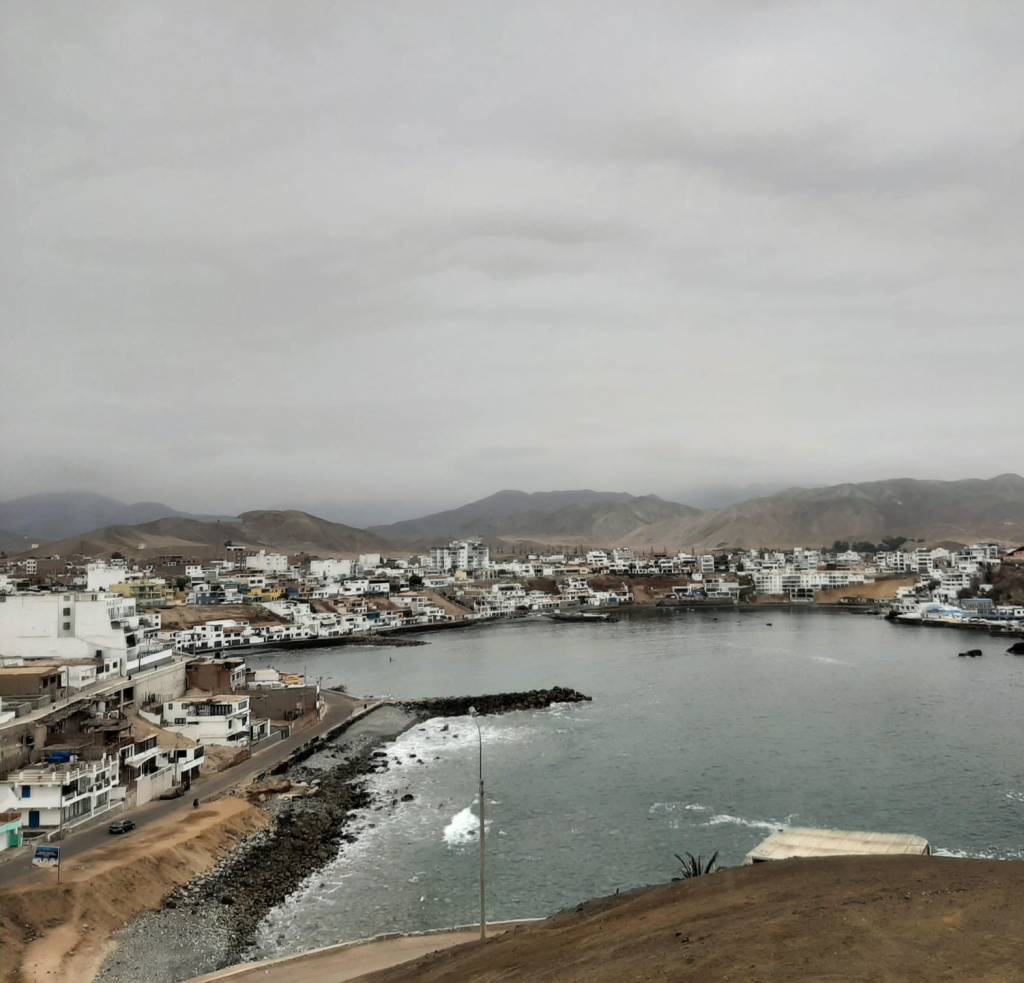
Soon after I got to Peru, I was walking along the boardwalk in San Bartolo. Several stories below the ocean crashed into the shore, unburdened by swimmers or surfers. Cevicherias sat empty, waiting for the summer crowd.
I’d decided to learn Spanish about a week before, so naturally I started eavesdropping on everyone I passed. You know, practice. Most of the time this yielded zero results, as any beginning language student knows. It’s all just gibberish at first, but I kept listening, waiting for a breakthrough.
An older couple was walking toward me. About ten feet ahead, they paused to glance behind a trash can. As they passed me, the woman said to the man, “Viste la paloma?”
For a second, nothing. Then the tumblers fell into place. Viste, did you see; paloma, pigeon. Could it be? Had I just understood?
One way to find out. Ten steps later I looked down behind the garbage can, and sure enough, there it was: a pigeon. Sandy brown with white splotches. Maybe injured, maybe eating. I picked up my pace; I think I even did a skip. Viste la paloma? Yes! I saw the pigeon!
I walked home feeling the buzzy excitement of victory. I’d understood! Spanish was not an incomprehensible blur! I even remembered totally random vocabulary (why did “paloma” stay in my head from high school? No clue, but now it’s linked in my mind to that couple in San Bartolo). It was a high like champagne.
At first, I thought the reason for my giddiness was that learning Spanish suddenly felt possible. That was a huge part of it, sure. But now that two and a half years have passed, I think about that moment sometimes, and not just in the context of learning a language.
Now, I see that moment in a larger context, a microcosm of a deeper truth: that really understanding something without an agenda is one of the most satisfying things in the world.
This is especially true in writing, in two ways. One: sometimes I feel a sense of interest or confusion or curiosity after an event or an idea, but can’t put my finger on why. Writing about it, honestly and open-endedly, can turn the lens and sharpen the image, point out the thing that was causing such a reaction. A lot of writers I know point to something like this as the reason they write. Like Joan Didion said, “I write to discover what I know.”
The other place it’s key is in ghostwriting. Understanding another person’s point is often harder than it sounds, because I’m so quick to assume I already know what they mean. But really that’s just projecting. Other people’s points are usually more nuanced and unexpected than we give them credit for. In normal life, we can choose how much attention to pay to that, but in ghostwriting, it’s the whole point: to lay down all one’s preconceptions and simply listen. Absorb. No agenda, no filling in the blanks with my own “stuff.”
When I can do that, when I can listen purely to understand, not to dispute or try to prove otherwise–then I see the pigeon. And with it comes that bubbly sense of accomplishment.

If you’ve been thinking about writing your book, but could use some structure and guidance, book a free call with me. I’m a ghostwriter and book coach, and I’d love to help you bring your story to life.
Learn more about my services here.
 Kimberly Bunker, MFA
Leave a comment