

When I was 19, I spent a month in Ghana. Inexplicably, in the months leading up to this, I pinned a strange hope on that trip: that when I came back, I’d be able to improvise on piano.
(This is exactly as illogical as it sounds. True, I would be taking drum lessons and a course on Music of a Developing Nation. But that was incidental. In retrospect, I now understand that I simply hoped that going abroad would change me.)
Earlier that year, sophomore year of college, I’d met a new group of friends. Hipsters. Musicians, poets, artist types who read their poetry at parties, wrote songs, listened to Radiohead, would later move to Brooklyn. I was enamored. Not with their cooler-than-thou attitude and vintage clothing, but with their passion. Their conversations. The way they wanted to play music, to write music, to fully engage with music in a way that I never had before. These people played music in front of people. Even if they weren’t that good at it (many weren’t), they still made music an integral part of their lives. They brought it out of the intensely private place of their own bedrooms and minds, and into the broad light of day–into conversations and social interactions.
I was surprised that I had something they didn’t: formal training. I’d taken piano lessons since age 4, which gave me the illustrious label of “classically trained” (a fancy term for spending a half an hour a week at my teacher’s house and practicing as little as possible in between). It meant I could read sheet music; it also meant that I had zero musical sensibility. I couldn’t play by ear. I couldn’t play with a band. I was useless without sheet music. Even a list of chord names meant nothing. A, C, F#? What do I do with that? I could play scales and arpeggios all day long. But I couldn’t use them in a song.
Musically, I was far inferior to my new friends. I couldn’t play the way they did, with love and abandon and innate talent. I was also too shy to play in front of anyone. But I desperately wanted to change that.
And so I began to link two unrelated ideas: that I would study abroad in Ghana, and when I came back, I would have this quality that I so adored in others. I would be able to play whatever I felt like on the piano, not just what was already written.
And with that wish beating in the heart of my subconscious, I got on a plane to Ghana.
Lots happened there. But suffice to say now that it was there that I first heard the name “Milan Kundera.” It came from Jess, a cool, often-barefoot girl from Colorado with a long brown braids. She invited me on an outing to the jungle and then a brewery with her and another girl.
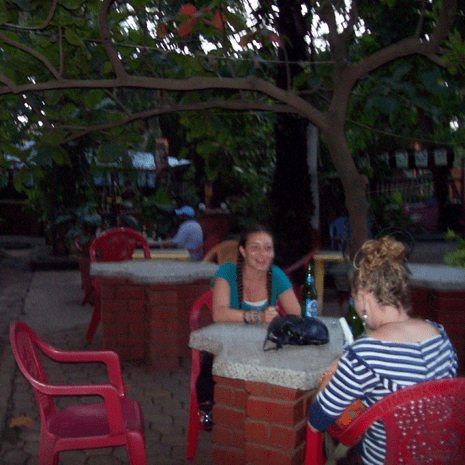
We couldn’t find the jungle and the brewery turned out to be just a factory, so we ended up at an outdoor bar, where, as we chatted over Star beers under palm fronds, she looked at me and said, “Have you ever read The Unbearable Lightness of Being?”
I had not. But the name was evocative enough that it stayed in my head. And so, weeks later, back in upstate New York, I picked up that book with the beautiful name and stumbled across the line, “She was silly enough to think that going abroad would change her.”
How naive I was, to think that another continent existed solely to shake me free of my own limitations.
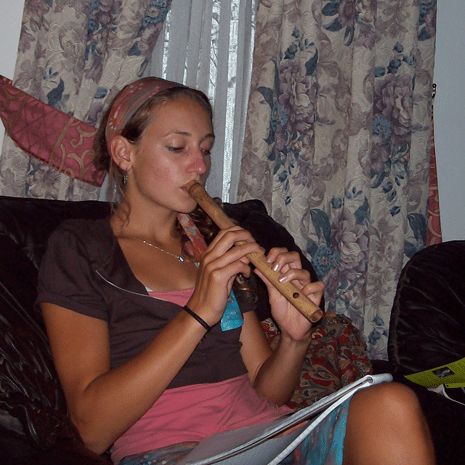
Since coming back from Ghana, I felt as lost and unmusical as always. Of course I could not improvise on the piano after I returned, no matter how different Africa was from what I knew. I still could not play freely, nor by ear, nor without the stiff puzzle of notes placed by someone else on a staff before me.
And yet…
And yet.
Going abroad changes you.
It does not fix your problems. No matter where you go, you are you. You cannot leave yourself behind anymore than you can outrun your shadow. Your past, your pain, your desires and hopes and failures—they are inside you as surely as are your organs.
But long-term, it changes you. Traveling somewhere new makes you realize all the things you take for granted—who to call if you’re in trouble, what to expect if you show up at something labeled “brewery,” how to find a bathroom in an unknown town. What you do in the evenings and how you make your breakfast and how you get back to center when you’re thrown off. Traveling makes you rely on yourself differently. It gives you the gift of experiencing yourself in a new context with a new set of possibilities and limitations. It adds to your wealth of experiences. And experiences are what change you.
Incidentally, today I can improvise freely on the piano. I can play the way my hipster friends did in college—not always well, but with love and abandon.
There’s no direct line linking that with my time in Ghana at 19. But it’s part of the long collage of things that changed me over time, leading me to see and hear music differently, to be willing to try new things, to be willing to be vulnerable in front of others.
Maybe what I’d hoped for so irrationally wasn’t so irrational. Maybe there is some odd link between traveling and being the person I wanted to be, doing the things I wanted to do. It was just on a longer timeline than I expected.
If you’re writing your memoir—or thinking about starting it—and could use some support, schedule a free call with me. Working with a writing coach is a fantastic way to bring your story to life.
To learn more about what a writing coach does, click here.
 Kimberly Bunker, MFA
Leave a comment