
If you’ve ever been to yoga class, you’ve probably — hopefully — heard some variation of this:
“Just notice.”
“Don’t judge.”
“Just observe the sensations that come up.”
This is the core essence of yoga, as I understand it.
(I used to think it was getting super flexible and doing cool arm balances that I could show off on Instagram. But now I know.)
And the older I get, the more I see how profoundly this applies to every aspect of life.
*
Take writing.
When you edit or read over something you’ve written (or something your ghostwriter/writing partner has written), the first impulse is often to label it. To jump to conclusions.
“This description is too long.”
“This section isn’t working, let’s cut it.”
What would happen if you just observed?
If you read the piece and just noticed what sensations came up?
If you said instead, “I feel confused during this paragraph,” or “I start to get bored during that description.”
See what happens? You’ve named the problem.
Now you can find a better solution.
(Where there is confusion, clarify; where there is tedium, trim, or make relevant.)
—
This practice is essentially “I statements.” Yet when we were taught to use I statements, most of us weren’t taught to first observe what’s happening in our bodies and minds. Instead, we learned to twist our interpretations into passive-aggressive, less-than-helpful contortions:
“I’m sorry you feel that way.”
“I wish you wouldn’t do XYZ.”
This happened in my MFA program, which was ostensibly based on us giving each other feedback that was based on observation rather than opinion (a radical concept, in theory).
In workshops, you’d hear things like “I observed that this piece is in present tense, and that there does not seem to be any discernible plot.”
In the few moments were people did give observation-based feedback, it was amazingly insightful:
“I felt confused as to why this character did ABC.”
“I was disappointed that the ending did XYZ.
“I felt excited when the narrator did 123.”
That’s the kind of feedback you can work from.
—
When we communicate based on our observations about our own experiences, without labels and interpretation, we can get to the core of the issue faster. We can forge stronger connections with those around us.
One more way to think of it: observations of our internal responses are like primary sources.
Our interpretations of our observations are like secondary or tertiary sources.
Primary sources tend to be more reliable, more precise, and more useful.
So as you write and rewrite, do as we do in yoga:
Just notice.
Don’t judge.
Just observe the sensations that arise.
💜 ✒️ 📚
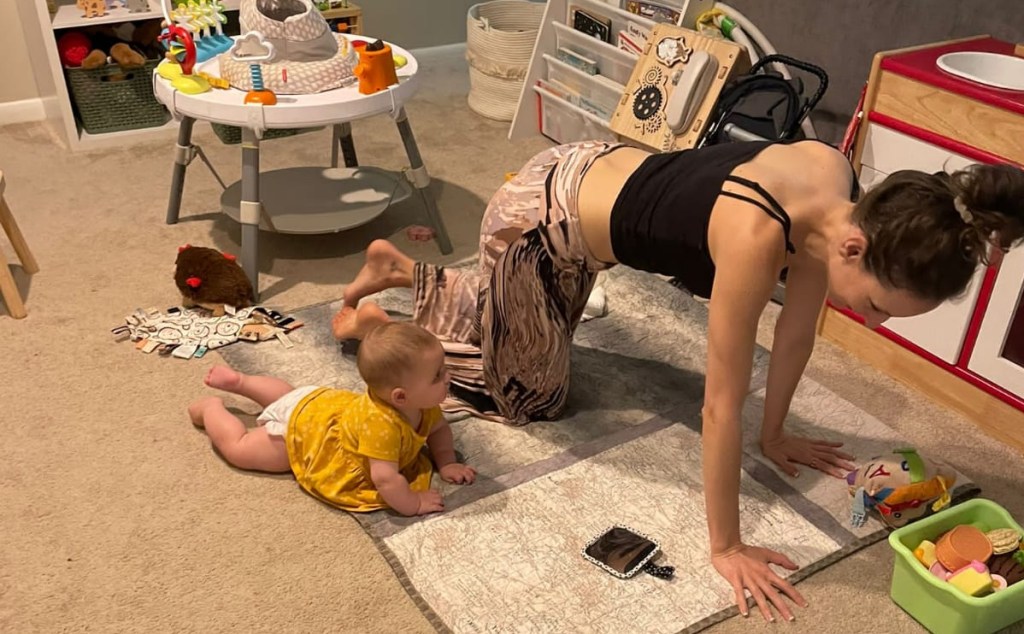
(P.S. This photo is me trying to do cat-cow with my niece right as she was learning to crawl.)
If you’re looking for support, guidance, structure, and accountability as you write your book, we might be a good match. Tell me a little about your project below and we can get started.
 Kimberly Bunker, MFA
Leave a comment